White paper: The Subscription Fatigue Cure
How Perpetual Licensing Slashes the 5-Year TCO of Smart Offices
Zoltan Arpadffy, CTO
Introduction
Tigermeeting is the leading on-premises solution for meeting room management, digital signage and access control — fully decentralized, serverless, and built for extreme scalability.
Designed for enterprise-grade reliability, it offers a perpetual licensing model with no hidden costs or cloud dependencies.
How could we achieve this? The answer is simple: We listen to our customers.
We own the technology. We know the industry. We are passionate about what we do.
We consider customer needs. We adjust our product and service roadmap accordingly.
Our consistent Blue Ocean strategy and focus on the market earned us respect from both customers and competitors.
We see that our products are able to provide great and affordable service for schools, universities, offices and organizations with simple, functional, efficient and reliable meeting room management solution - that is already highly appreciated worldwide.
Executive Summary
In the rush to modernize office spaces, organizations have unwittingly walked into a "Subscription Trap." While the Software-as-a-Service (SaaS) model revolutionized IT by lowering barriers to entry, it has created a burden of indefinite recurring costs for infrastructure that should be stable assets.
This white paper analyzes the financial impact of meeting room management systems over a standard 5-year hardware lifecycle.
We compare the dominant Cloud/SaaS model against Tigermeeting’s Serverless On-Premises model. The data demonstrates that by utilizing a Perpetual Licensing strategy (CapEx) rather than a subscription model (OpEx), enterprises can reduce the Total Cost of Ownership (TCO) by up to 70%, achieving ROI typically within 18 to 24 months.
The Context: Infrastructure vs. Service
To a CFO, a meeting room panel is not a "service" like an email platform or a CRM; it is digital building infrastructure. It is akin to an HVAC controller, a security camera, or an elevator system.
Historically, infrastructure is purchased, depreciated, and owned. However, the current market is dominated by SaaS providers charging monthly fees for room panels. This forces organizations to "rent" the functionality of their own physical spaces. When you stop paying the monthly fee, the screen on the wall goes dark, rendering the hardware useless. This mismatch between asset type (hardware) and billing model (subscription) is the primary driver of inflated TCO.
The "Rent vs. Buy" Analysis
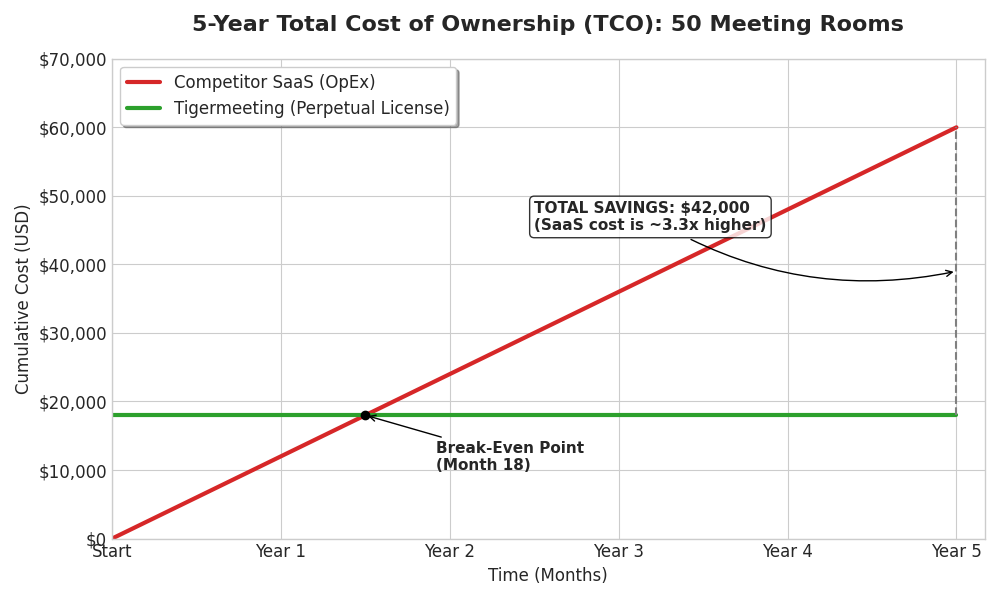
The most compelling argument for Tigermeeting is purely mathematical. Below, we project the cumulative costs of a 50-room deployment over 5 years.
Scenario:
Competitor SaaS: $20 per room/month (Standard enterprise rate).
Tigermeeting: One-time perpetual license fee (Estimated equivalent to ~1.5 years of SaaS payments).
Scope: 50 Meeting Rooms.
The Crossover Point (The Break-Even)
As illustrated in the projection above, the cost curves intersect between Month 18 and Month 24.
Year 1: The SaaS model appears to require lower upfront cash flow.
Year 2: The cumulative cost of SaaS surpasses the one-time cost of Tigermeeting.
Years 3-5: The divergence becomes extreme. Every month, the SaaS solution effectively taxes the organization an additional $1,000 (for 50 rooms), while the Tigermeeting cost curve remains flat at zero.
The Result
By Year 5, the SaaS solution has cost the organization roughly 300% more than the Tigermeeting solution for the exact same utility.
The Strategic Shift: CapEx vs. OpEx
For Procurement and Finance departments, how money is spent is often as important as how much is spent. Tigermeeting aligns with a Capital Expenditure (CapEx) strategy, which offers distinct advantages for facility upgrades:
-
Asset Capitalization: A perpetual license is an asset that can be capitalized and depreciated over time, improving the balance sheet compared to the "black hole" of OpEx spending.
-
Budget Certainty: With a one-time purchase, the cost is known, fixed, and paid. There is no risk of the vendor raising subscription prices in Year 3 or 4, protecting the organization from inflationary service costs.
-
Simplified Procurement: One invoice, one payment, one contract. This eliminates the administrative overhead of managing monthly or annual renewals, PO generations, and license audits.
-
The CFO’s Perspective: "We should not have to pay a monthly rent to unlock the door of a meeting room we already own."
The Hidden Costs of the Cloud
The license fee is only the visible tip of the iceberg. Cloud-based meeting management introduces indirect "hidden" costs that inflate the real TCO. Tigermeeting’s serverless, on-premises architecture eliminates these entirely.
| Cost Driver | Cloud/SaaS Solution | Tigermeeting (On-Prem) |
|---|---|---|
| Bandwidth & Network | High Cost: Constant "heartbeat" traffic to the cloud requires robust internet bandwidth. 50 screens pinging external servers 24/7 consumes measurable capacity. | Zero Cost: Traffic is contained within the LAN. No external internet bandwidth is consumed for device operations. |
| Tiered Features | Upselling: Standard plans often block essential features (e.g., RFID authentication, custom branding) behind "Enterprise" paywalls. | All-Inclusive: The perpetual license includes all features. No "unlock fees" for standard functionality. |
| Change Management | Forced Updates: SaaS vendors push UI changes automatically, often requiring staff retraining and updated internal documentation. | Controlled Updates: You decide when (and if) to update the software, preventing unexpected disruptions and retraining costs. |
| Hardware Dependency | SaaS Capability: SaaS vendors are forced to use more expensive screen brands that support external APIs needed to communicate with the cloud services | Direct Screen Drivers: As Tiger application runs on the screen, directly supports all hardware features allowing for much wider hardware choice. |
Why Tigermeeting Can Afford This Model?
How can Tigermeeting offer a perpetual license when the industry standard is subscription? The answer lies in the Serverless On-Premises Architecture.
SaaS competitors must charge you monthly fees because they have to pay Amazon (AWS) or Microsoft (Azure) to host your data on their central servers. They pass their cloud computing costs on to you, with a markup.
Tigermeeting does not host your data. Your data lives on your devices (Distributed Database).
Because Tigermeeting has no recurring cloud hosting costs associated with your deployment, they do not need to charge you a recurring fee. The savings from this efficient architecture are passed directly to the customer in the form of a one-time license.
Conclusion
In an era of "Subscription Fatigue," where every piece of software demands a monthly tithe, Tigermeeting offers a return to financial sanity.
For the CFO, the choice is clear:
-
Reduce TCO by up to 70% over the hardware lifecycle.
-
Convert unpredictable OpEx into fixed, depreciable CapEx.
-
Eliminate the risk of future price hikes.
By choosing the serverless, perpetual licensing model, organizations are not just buying software; they are making a fiscally responsible investment in their own infrastructure.
---
Download the whitepaper here
